
You've seen the demos. You've read the LinkedIn posts about "unprecedented productivity." You've finally pulled the trigger on a team-wide subscription to a powerful AI tool like Claude or ChatGPT.
But when you check the usage logs a month later, it's a ghost town.
Your team isn't lazy. They aren't trying to sabotage the company. And they certainly aren't "anti-tech." If you look closer, what you're likely seeing isn't a lack of interest, it's a freeze response.
At Deb Delivers, I approach AI differently. With 13 years of experience in the mental health field and a deep background in Dialectical Behavior Therapy (DBT), I know that when the nervous system perceives a threat, it doesn't matter how "efficient" a new tool is. If your team feels threatened, they will shut down.
In this post, we're going to get real about the hidden cost of AI anxiety and how we can move from tech-induced paralysis to a calm, human-centric workflow.
The Psychology of the "Freeze"
In the world of mental health, we talk a lot about the window of tolerance. It's that sweet spot where you can handle stress, learn new things, and stay productive. When a massive technological shift like AI hits a workplace, it often pushes people right out of that window.
According to research recently highlighted by Harvard Business Review, AI anxiety isn't just about "losing jobs." It's about a loss of agency, a fear of making a high-stakes mistake, and the overwhelming noise of the 24/7 AI news cycle.
When your team faces a fire hose of new updates every morning, their brains don't think, "How can I use this to save ten minutes?" Their brains think, "I can't keep up, so I'm just going to stay safe and do things the old way."
That is the Freeze Response. It's a protective mechanism. To unfreeze them, we don't need more "how-to" videos, we need a guided, empathetic approach that centers the human, not the software.
"Human in the Loop" is More Than a Buzzword
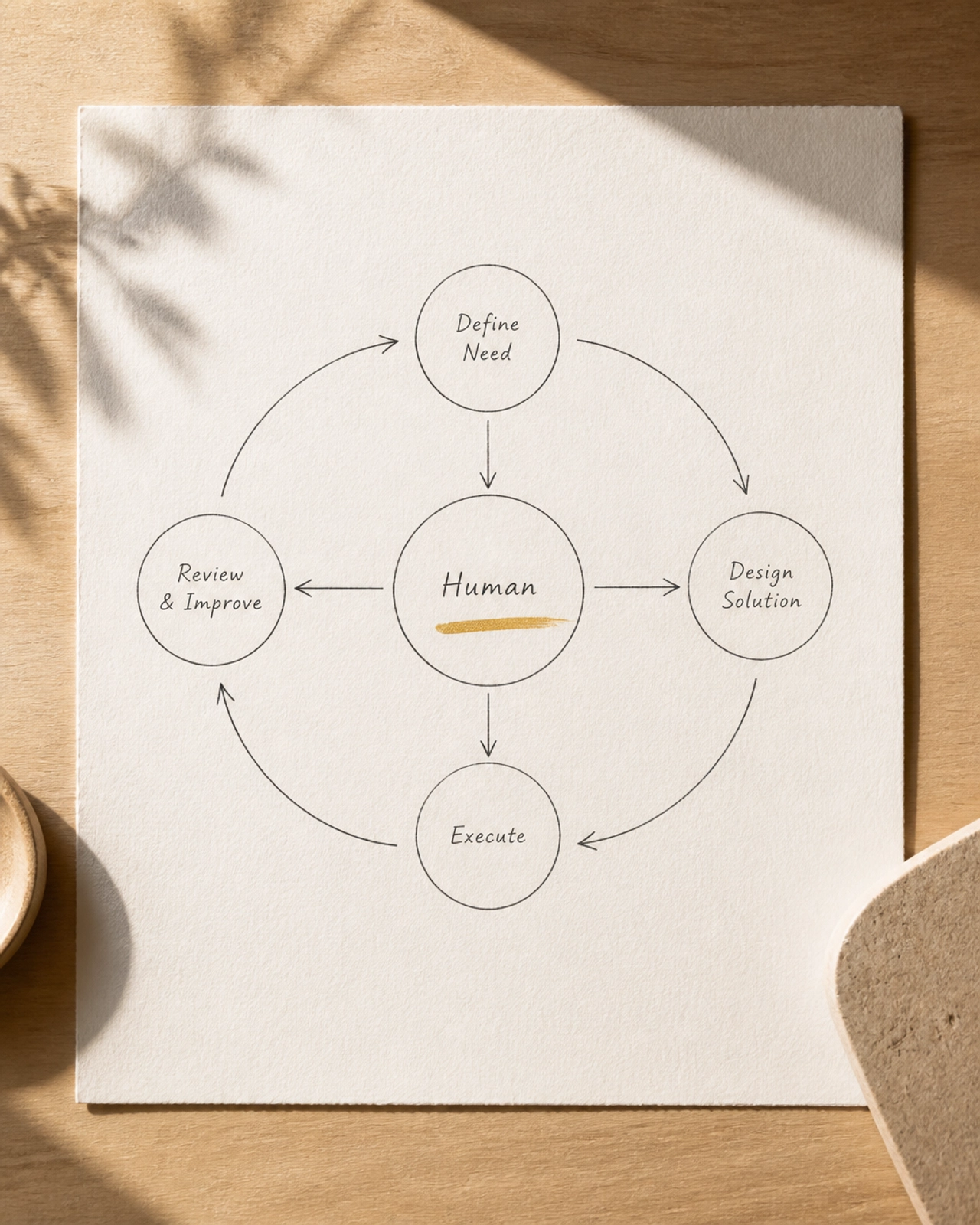
You might have heard the term "Human in the Loop" (HITL) in technical AI discussions. In my practice, it's a foundational philosophy.
AI should create space for meaningful work, not replace it. My goal is to design intelligent systems that think clearly and act ethically, but most importantly, still sound like you.
When we implement flow-based automation or agentic workflows, the human remains the judge, the editor, and the soul of the operation. When a team understands that the AI is there to amplify their unique judgment rather than replace their voice, the anxiety begins to lift.
I've spent over a decade helping people navigate complex emotional landscapes. Applying those same DBT principles, like mindfulness and distress tolerance, to the adoption of AI allows us to build systems that reduce friction rather than creating it.
Cutting Through the Noise with AI Fluency
It's easy to feel like you're failing at AI because you didn't master five new tools this week. I call this "AI FOMO," and it's a fast track to burnout.
Instead of chasing every shiny object, I focus on foundational excellence. I recently completed the AI Fluency and Claude Cowork certifications through the Anthropic Academy. Why Anthropic? Because their models, like Claude, are built with a "Constitutional AI" approach that prioritizes safety and nuanced, emotionally intelligent outputs.
These certifications aren't just badges, they represent a commitment to a structured, calm way of working with AI. AI Fluency is about understanding the why and the how of collaboration. Claude Cowork is about agentic systems: AI that can actually plan and execute multi-step tasks alongside you, rather than just spitting out generic text.
By focusing on these robust, reliable frameworks, I help businesses move away from the fire hose and toward a curated, intentional tech stack.

How to Unfreeze Your Team
If you've invested in AI and aren't seeing the results, it's time to change the approach. Here is how we start the thaw:
- Validate the Discomfort: acknowledge that the pace of change is exhausting. In DBT, validation is the first step to change. Don't tell your team they should be excited, ask them what they're nervous about.
- Manage the Pace: stop the constant rollout of new tools. Choose one or two high-impact workflows and master them. Excellence over volume.
- Prioritize the Human Voice: ensure your prompts and automations are designed to preserve the human element. If the AI output sounds like a robot, your team will feel like robots.
- Invest in Guided Training: don't just hand over a login. Provide a space where they can experiment without the fear of "breaking" something or doing it "wrong."
Let's Design a System That Breathes
At the end of the day, AI is a tool. Like any tool, from a fountain pen to an n8n workflow, it only works if the person holding it feels confident and capable.
I design systems for values-driven businesses that want to grow without losing their integrity or their connection to their team. If you're a founder who feels the operational complexity of your business outpacing your capacity, you don't need more software. You need a system that reduces friction and restores your focus.
Whether it's custom automation using n8n and Zapier or deep-dive coaching to build your team's AI fluency, I'm here to help you navigate this transition at a pace that feels sustainable.

Ready to move from anxiety to action? Let's talk about how we can integrate AI into your business responsibly, strategically, and with a human-centered touch. Whether it's individual coaching or team training, we'll build a system that finally works for you and your team. Get in touch.

Debbie DeMarco Bennett is the founder of Deb Delivers, an AI coaching, training, and consulting practice, and of DBT Path.